AWS Device Farm meters the device. We price the company. That is the whole difference, and it decides who in your company ever sees the build.
Device Farm charges $0.17 per device minute, or $250.00 per slot per month unmetered, at the AWS account level as of July 2026. VibeView charges for the organisation: Professional is $249 a month, 25 concurrent sessions, no member limit. So the fourth person who wants to open the build — the PM, the designer, the prospect — is a cost decision on one side and a link on the other. Most people searching for an AWS Device Farm alternative are not stuck on devices. They are stuck on access.
Obviously we want you to pick us. So here is the honest version, including the cases where we would tell you to stay.
See it before you weigh it. Open a VibeView share link and use a real build in your browser — no install, no account, no slot reserved for you. Then put your own build on the free tier: two sessions at once, 30 streaming minutes, a dollar of credit, no card.
AWS Device Farm alternatives: how VibeView compares
| What you are deciding | VibeView | AWS Device Farm |
|---|---|---|
| What does one more device running at the same time cost? | Nothing extra — Professional is $249/month for 25 concurrent sessions and unlimited members; 3,000 streaming minutes included, then $0.04/min | $0.17 per device minute, or $250.00 per slot per month unmetered, applied at the AWS account level (July 2026) |
| Is the free option a tier or a trial? | A tier — free indefinitely, no card, 2 concurrent sessions and 30 streaming minutes that refill every month, in 5-minute sessions | A one-time trial of the first 1,000 device minutes, which their pricing page notes is temporarily up from 250 (July 2026) |
| Can several people join and interact with the same live session at once? | Yes — a host mints a link and guests join the running session as viewers or controllers, live | No — a remote access session displays the single device you select when you start it; more devices at once means starting more separate sessions, not sharing one |
| Can you drive a device in the browser and read the logs afterwards? | Yes — stream the session and interact with it; device debug logs stream too | Yes — remote access lets you swipe and gesture in real time, with video, screenshots and device, network and activity logs |
| Does your build server get an answer it understands? | Yes — pass or fail in JUnit or JSON, pinned to one build | Yes — a Jenkins CI plugin, the AWS CLI and SDKs, plus a managed Appium endpoint added in November 2025 |
Two of those rows are ties, and Device Farm earns them. The two that are not are both about money, and both compound with every person you add.
What else you get with VibeView
A link anyone can open
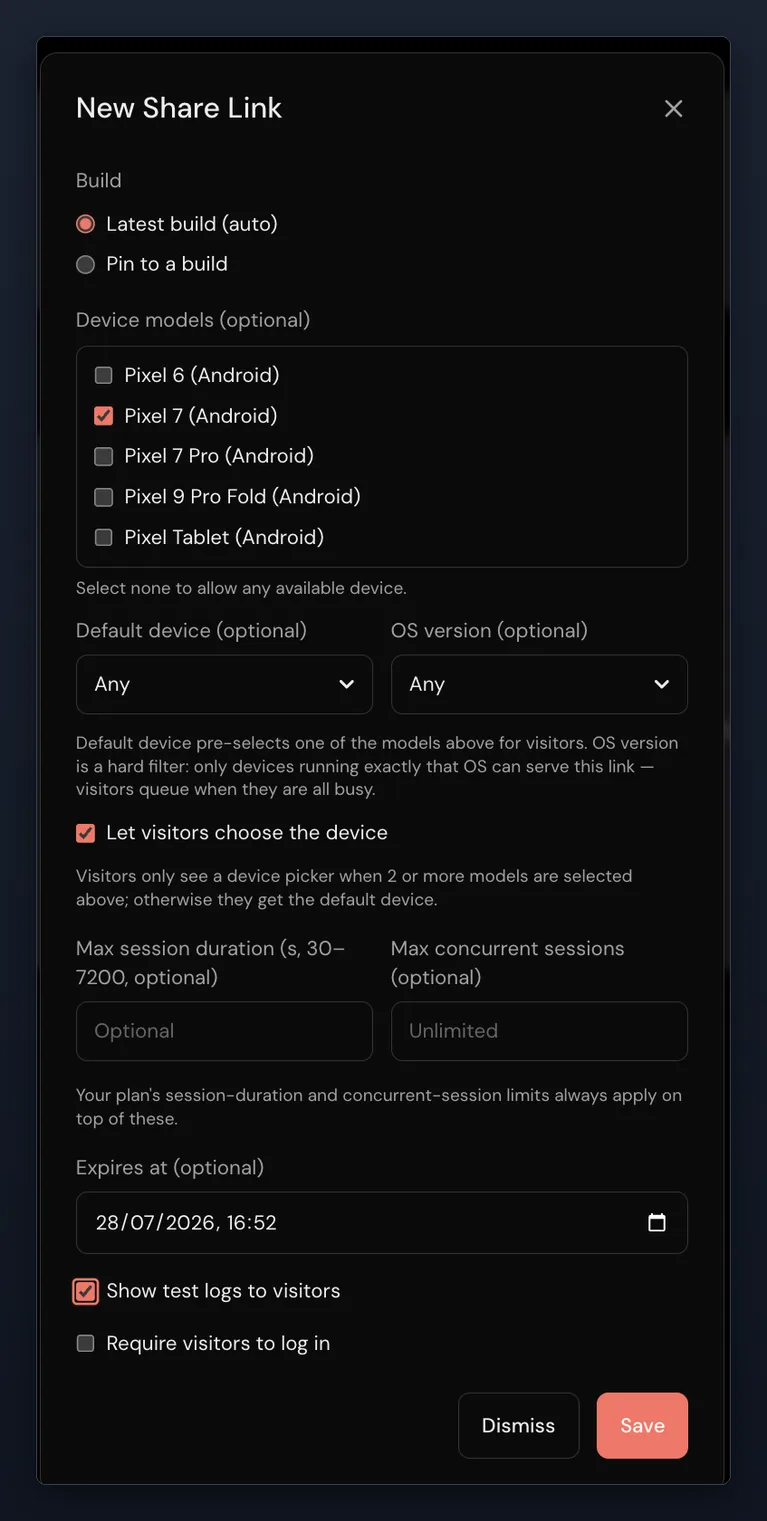
Send a running build to a PM, a support lead or a prospect. No install, no account, no seat. You choose the devices, the session length and when the link stops working.
A device inside your own page
The SDK drops a live simulator into your docs, your changelog or your pricing page — one domain on Starter, unlimited on Professional. Readers tap through the real app without leaving.
Your laptop, on a cloud phone
Point it at the project you are working in and the phone updates about a second after you save. That works for iPhone from Windows or Linux, with no Mac anywhere.
Replay first, AI only when it must
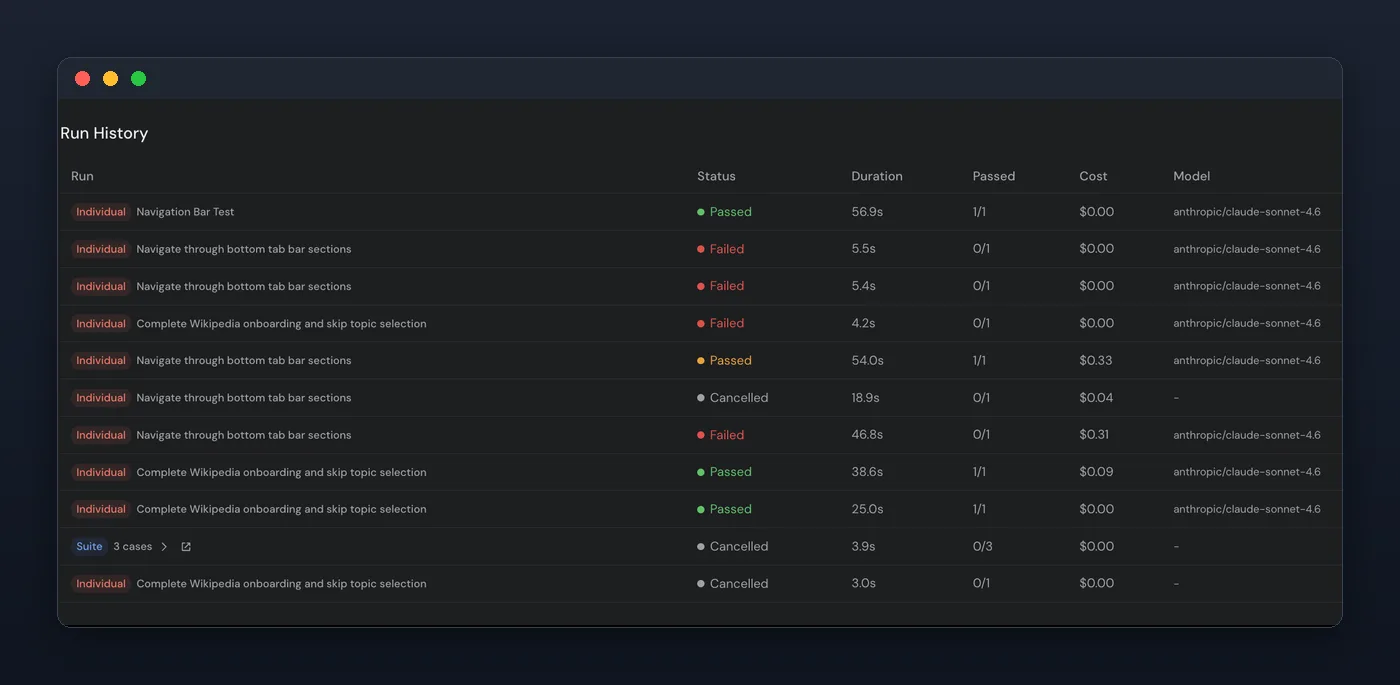
Recorded steps replay exactly as recorded. The agent steps in only where the screen actually changed, so one moved button does not break the suite the morning after.
Your own AI key
Bring a key from your own provider on every plan, including the free one. Model spend lands on their invoice at their rate, with nothing added by us.
TV, not an afterthought
Apple TV and Android TV sit beside phone and tablet, driven by real focus movement rather than guessed remote presses. Roku is in beta.
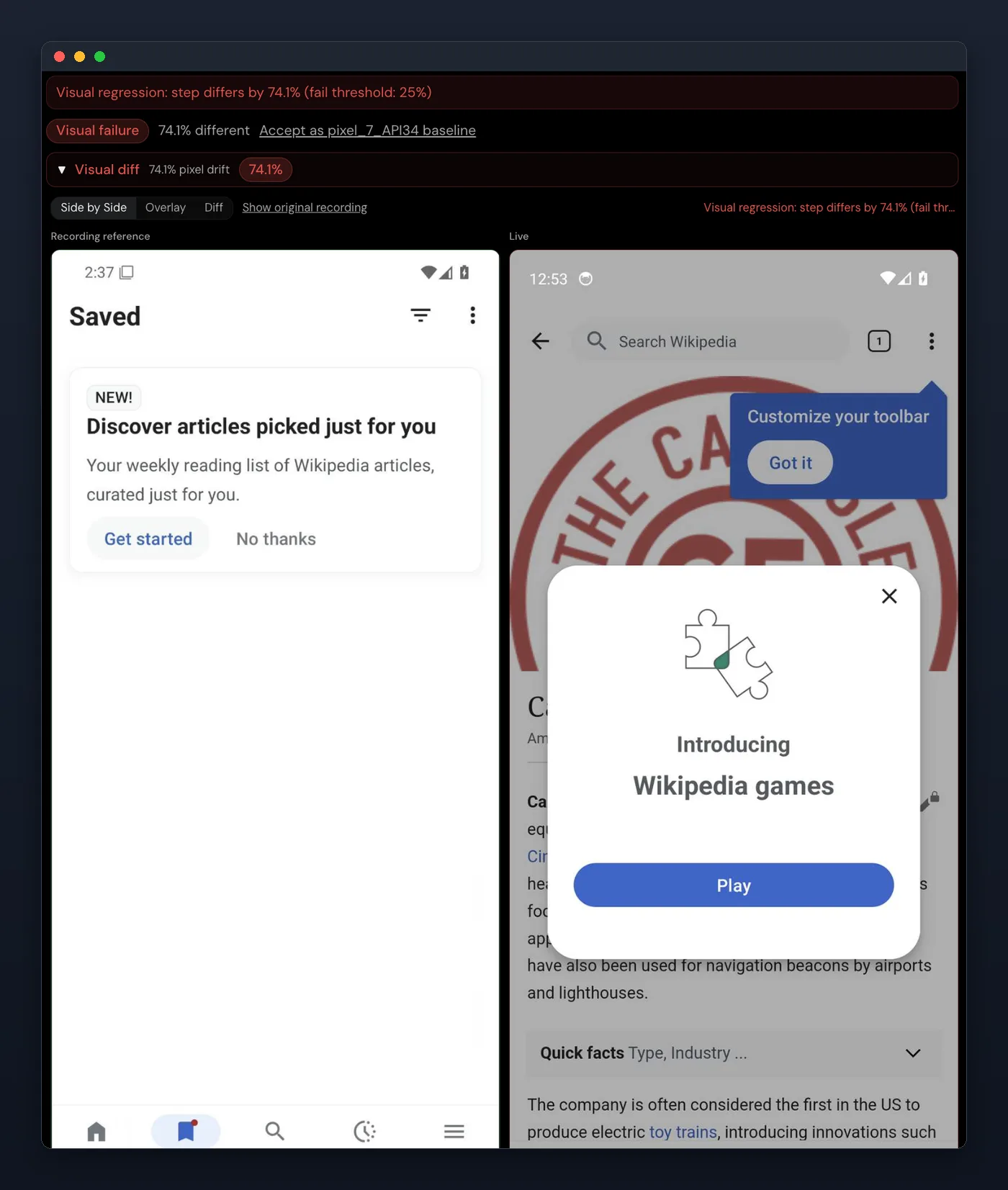
The run stops at the step where the screen broke, not at the end. Every step is checked against its own baseline mid-run, with separate warn and fail thresholds, and a screen that changed on purpose becomes the new baseline in one click.
Put it in front of one person who is not an engineer. Create a share link, pin it to your build, set it to expire tomorrow, and send it to whoever keeps asking what the change looks like. That is this page's argument, tested on your app.
When do physical devices and existing Appium suites settle it?
Three things go to them, and each is a reason to stop reading this page. They test on real, physical phones and tablets, so a camera bug, a Bluetooth peripheral or an OEM firmware quirk is visible to them and invisible to us — we run simulators and emulators, and that gap is not one we are closing. They run the Appium, XCTest and Android Instrumentation suites you already have, where VibeView means re-authoring those flows in its own format — a genuine switching cost, and not a small one. And Device Farm documents SOC, PCI, FedRAMP and HIPAA compliance, so if your procurement review turns on a certification list, start there and talk to us second.
Try it on your own build
AWS Device Farm vs VibeView comes down to one question you can answer today: when someone who is not an engineer asks what the change looks like, how long does it take to show them? Upload your build, create a link, time it.
Two sessions at once, 30 streaming minutes, a dollar of credit, no card — see what the free tier includes. Or send us your workload and we will tell you plainly whether it fits, including when it does not.
Published 30 July 2026 · AWS Device Farm pricing and capabilities verified 30 July 2026