If you are searching for a LambdaTest alternative because a running build needs to reach someone who will never install it — the PM, the support lead, the designer, the prospect halfway down your pricing page — that is the job VibeView is built for. A live iOS simulator or Android emulator plays inside your own web page, or behind a link that needs no install and no account. LambdaTest is broader than us on hardware and browsers, and that has its own section further down.
One thing to know before you price anything. LambdaTest rebranded to TestMu AI on 12 January 2026 and now calls itself a full-stack agentic AI quality engineering platform. It is a real bet and they have built hard behind it. As of January 2026 that pricing is presented as six separately billed products — Live Testing, Automation, HyperExecute, Smart UI, KaneAI and Test Manager — each with its own free tier, rather than the single subscription you may remember.
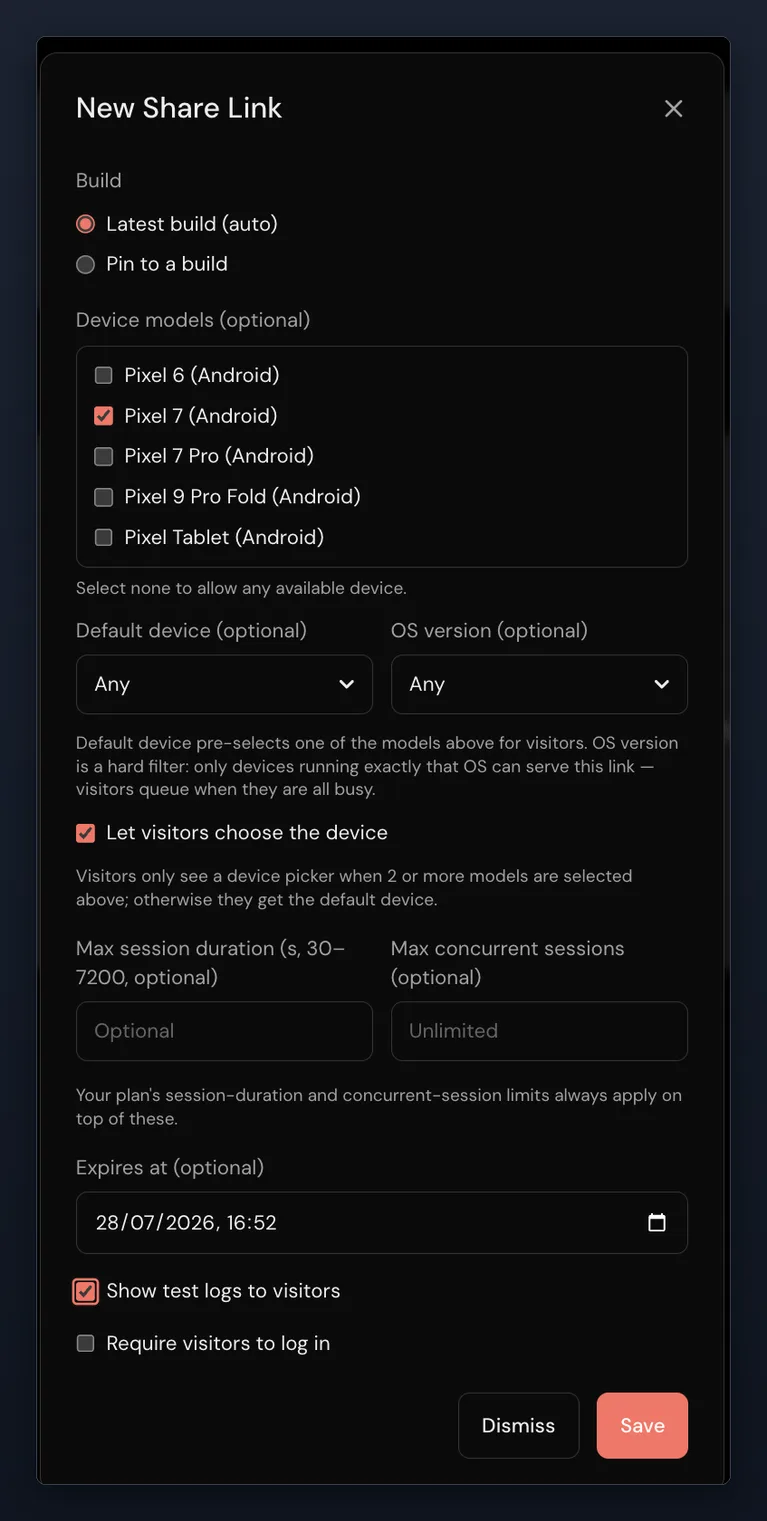
Check it on your own build first. Put your current build on the free tier and send one link to someone who is not an engineer. Two sessions at once, 30 streaming minutes, a dollar of credit, no card — and free sessions stop at five minutes each, so this is enough to prove the link works and not enough to run a suite.
LambdaTest alternatives: how VibeView compares
| What you are deciding | VibeView | LambdaTest |
|---|---|---|
| Can the device live inside your own docs or pricing page? | Yes — a React component or a share link, revocable, pinnable to one build | Sessions launch from the dashboard, automation grids and tunnels |
| Can several people join and interact with the same live session at once? | Yes — a host mints a link and guests join the running session as viewers or controllers, live | No — sharing is documented as a link to completed automation logs or execution videos by session ID, not concurrent access to a session in progress |
| Do you know which model ran your test, and whose invoice it lands on? | Your own provider key on every plan including free; each run records the model and the cost | A hybrid stack of third-party models with an in-house agentic framework, with model names disclosed under NDA |
| How many products do you buy to cover one app? | One — $0 to $249 a month, streaming and AI from a single pool | Six separately billed products as of January 2026, priced by concurrent parallel sessions rather than seats |
| Can you reload your local code onto a cloud device? | Yes — your project on a cloud phone about a second after you save, including iPhone from Windows or Linux | Builds are uploaded from CI or the dashboard, then run on real devices |
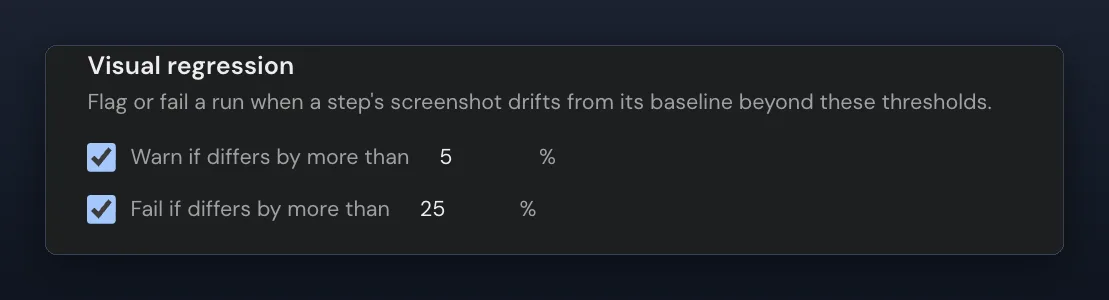
| When does a visual difference stop a run? | After every step, against warn and fail thresholds set per suite | SmartUI captures screenshots triggered from automation scripts at chosen points and compares them across builds |
That is the short version of VibeView vs LambdaTest. Most of those rows come back to two questions: whether a person who does not live in a testing dashboard can reach your app, and whether you can see what the automation did and what it cost.
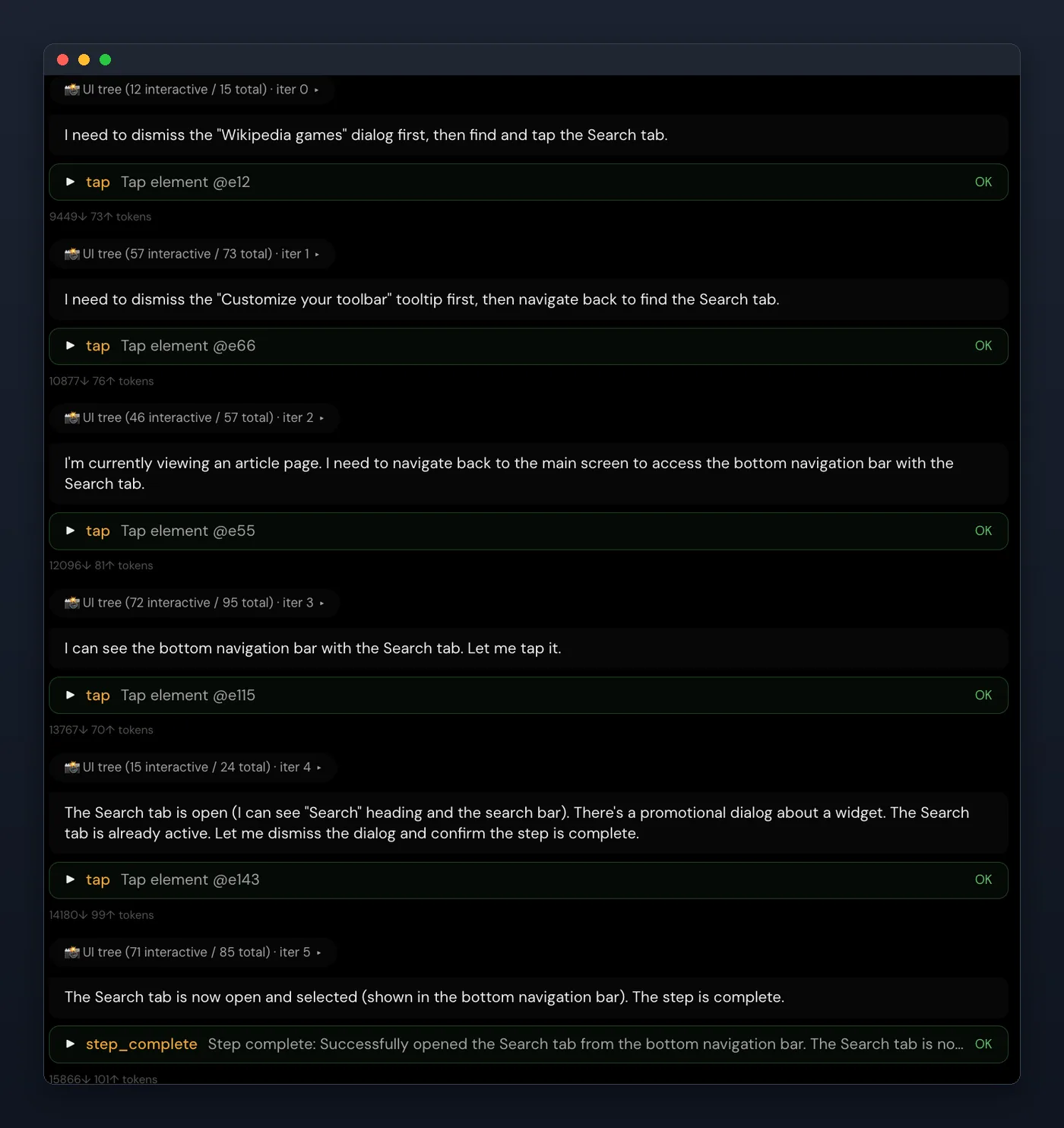
When a test fails, the question is always the same: what did it actually do? Every iteration the agent took is kept — what it saw, what it decided, which element it tapped and what came back. You debug a transcript, not a verdict.
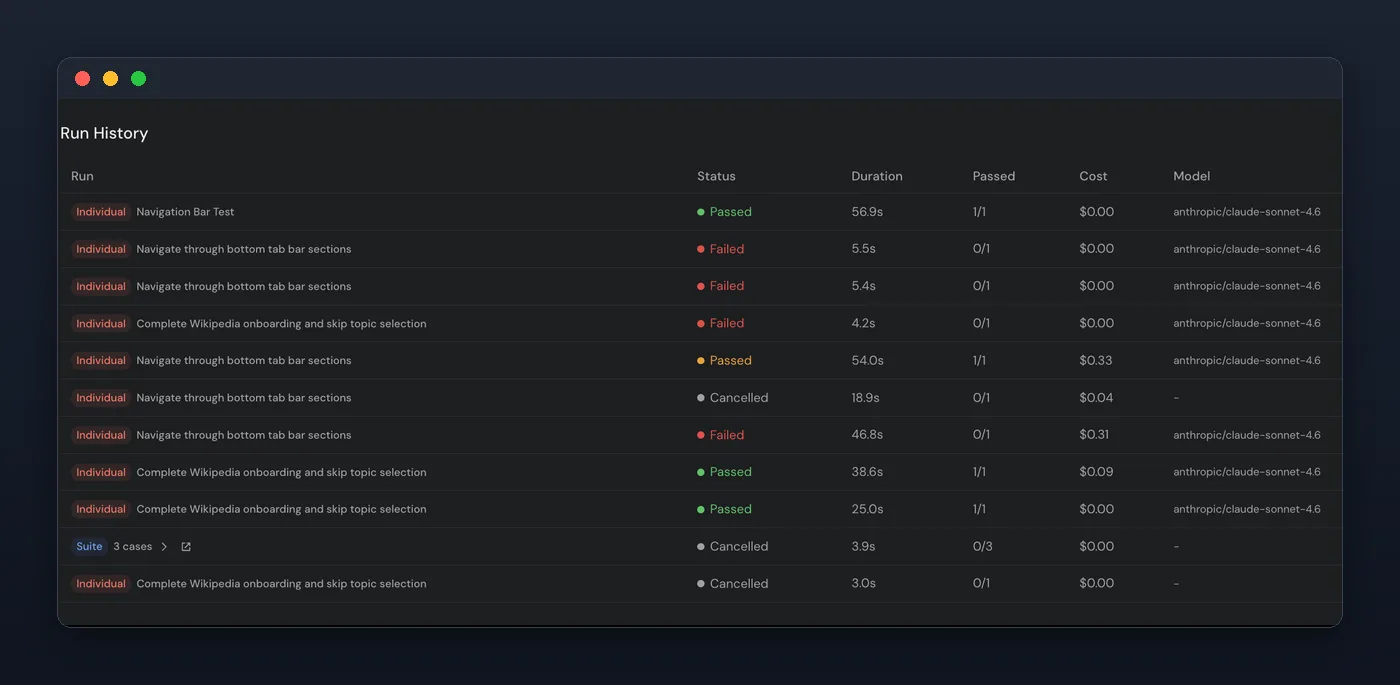
The same goes for what it cost. Every run is stored with its duration, its outcome, the model that drove it and the price of that run, so the AI line on your bill has a per-run breakdown behind it instead of a credit balance going down.
What else you get with VibeView
A link anyone can open
Send a running build to a PM, a support lead or a prospect. You choose the devices, the session length and the day it stops working.
Your own AI key, or none
Bring a key from Anthropic, OpenAI, Google or OpenRouter on any plan, including free. Model spend goes to their invoice at their rate. Skip the key and it draws on your credit instead.
Recordings that survive a redesign
Recorded steps replay exactly as captured. The agent only takes over where the screen actually changed, so one moved button does not cost you a morning.
Your laptop, on a cloud phone
Point it at the project you are working in and the device updates about a second after you save. That includes iPhone from Windows or Linux, with no Mac in the room.
TV apps beside phone and tablet
Apple TV and Android TV run as first-class targets, driven by the focus model rather than blind d-pad presses. Roku is in beta — streaming and inspection only, no sideload yet.
A bill with a ceiling
Streaming is metered and overage can be switched off, so sessions stop rather than bill you. You set the number your finance team has to live with.
When is LambdaTest the better choice?
Several things go to them outright, and each one is a reason to stop reading this page. They rent real devices and run a browser grid, so a camera fault, a radio bug or a Safari rendering difference is visible to them and invisible to us — and their Smart TV cloud automates real Apple TV, Fire TV and Roku hardware, where we run TV simulators. They also record network traffic and export it as HAR, which we do not do at all, and they run the Appium, Maestro, XCUITest and Espresso suites you have already written, where moving those flows to us would mean re-authoring them.
Try it on your own build
Upload the build your team made this morning and send one link to someone outside engineering. If they get somewhere useful without asking you a question, that is this entire page proved on your own app inside ten minutes.
Two sessions at once, 30 streaming minutes, a dollar of credit, no card — see what the free tier includes before you plan around it. Or send us your workload and we will tell you plainly whether it fits.
Published 30 July 2026 · LambdaTest pricing and capabilities verified 30 July 2026