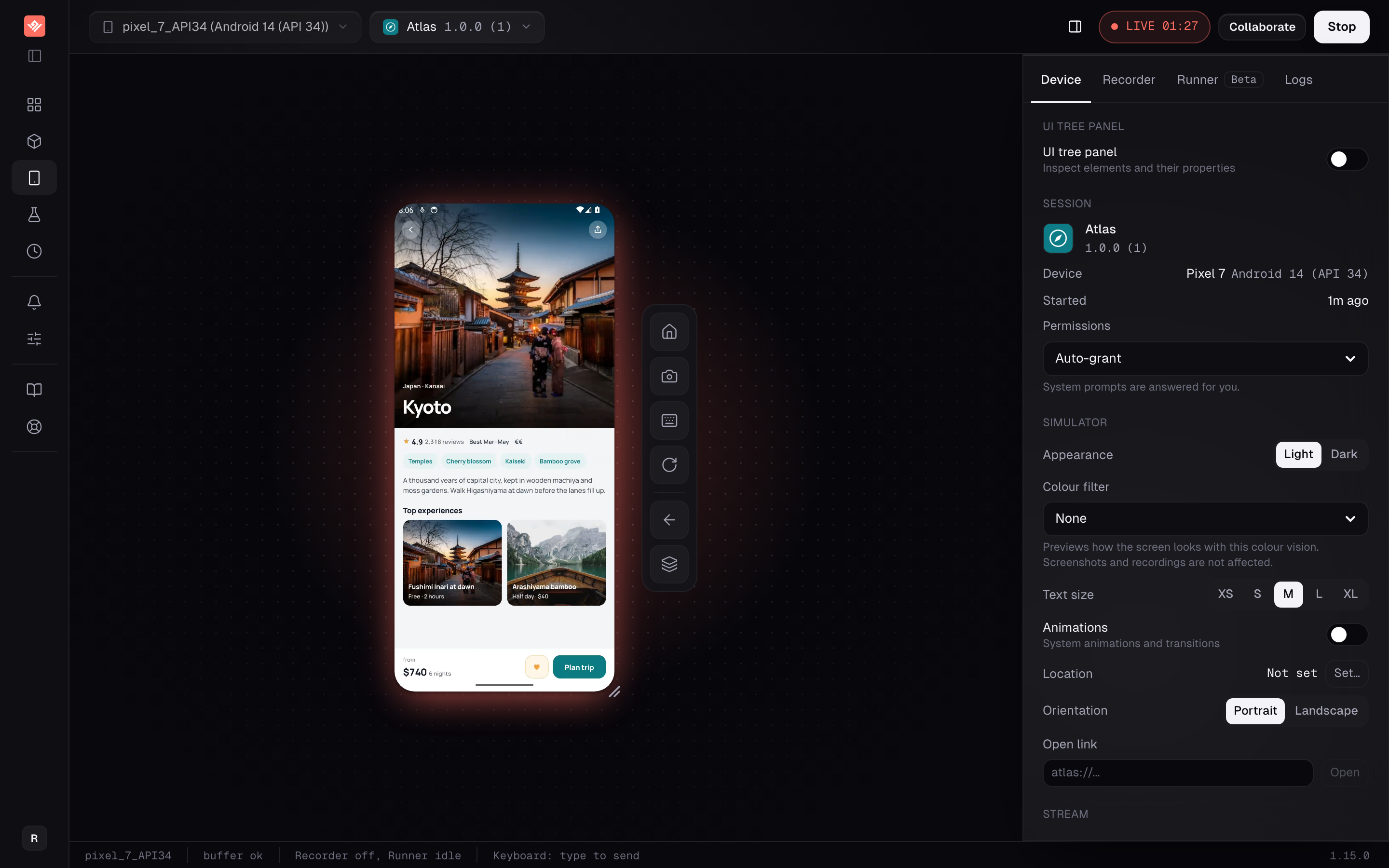
You can already run an Android emulator on your laptop, free, on any operating system. That is not the problem.

The problem is the second one. And the twentieth. And the one you need to hand to a customer who has no toolchain, the one you want running inside your documentation, and the one that has to fail a pull request at two in the morning. A local emulator is a single-player tool. VibeView runs them in the cloud and gives every one of them a URL.

Who this is for

QA teams with no device lab, and teams whose Android build needs to be reachable by people who do not build Android. If you are one developer testing one app on one machine, keep your local emulator — it is faster and costs nothing.

What you get

More than one at a time

Run 2 concurrent sessions on Free, 4 on Starter and 25 on Professional, shared across everyone in the organization. Pick a device group and start, or queue and start automatically when one frees up.

Tests that survive a moved button

Recorded steps replay exactly, and an agent picks up only the steps where the screen actually changed. One design change costs one step instead of a red suite.

A device anyone can open

Send a URL and the recipient uses your app in their browser, with no install and no account. Or embed the device in your own site behind a domain-locked iframe.

A gate in your pipeline

The CLI runs a suite and returns JSON or JUnit with exit codes. Results come back as GitHub commit statuses, webhooks or Slack messages, pinned to the build that produced them.

Running more than one

Every session names the app it is running and the exact device and OS it is running on, so a bug report says "Pixel 7, Android API 14" rather than "my emulator". Identical devices are pooled, so you choose a kind of device rather than a machine.

The Configuration sidebar of a running device session: the app under test (Wikipedia, “Android — devices filtered”), an Active Device of Pixel 7 on Android API 14, Show/Hide toggles for Device Controls, QA Tools and Developer Tools, a Permissions choice of Auto-grant or Manual, and a red Stop Session button.
A running session, with its app and device named. View full size →

Testing without writing a framework suite

Record a flow by using the device and it becomes a test of numbered plain-English steps. Visual regression then compares each step against its own baseline, held per device model, with separate warn and fail thresholds — so a run stops at the step that changed rather than at the end.

A failed step in a run report. A red banner reads “Visual regression: step differs by 74.1% (fail threshold: 25%)”, beside a “Visual failure” badge, “74.1% different” and an “Accept as pixel_7_API34 baseline” link. Side by Side, Overlay and Diff views are offered; Side by Side shows the recording reference on the left and the live device on the right, where a promotional dialog covers the screen.
A failed step, with the reference and the live screen side by side. View full size →

AI test authoring is beta. A run can be set to replay only, with no agent involved.

Handing the app to someone else

A share link is an ordinary URL that plays your app on a live device. You choose which build it serves, which devices it offers, how long a session runs, whether it expires and whether visitors must log in — and you can revoke it at any point.

The Share tab of an app, headed “Share Links”, with a “New Share Link” button and one link listed: an “Active” badge, “Latest build (auto)”, “created Jul 27, 2026”, the URL https://vibeview.io/app/share_voijc79bgsnaxxxk8d0dhsij, and Copy, Edit and Revoke controls.
A share link, with its copy, edit and revoke controls. View full size →

To put the device inside your own pages instead, an embed key gives you an iframe you can lock to your domains. Embedding needs Starter or above.

If the concern is an unreleased build living on someone else's machines: builds are scoped to your organization, members hold roles rather than shared access, changes are written to an audit log, and every link and key is revocable on the spot. Ask us about your procurement requirements directly rather than trusting a marketing page.

In your pipeline

Runs are kept with their status, duration, cost and the model that drove them, so a failure three weeks ago is still there with its evidence attached.

A suite's Run History table with columns Run, Status, Duration, Passed, Cost and Model. Rows mix Individual and Suite runs with statuses Passed, Failed and Cancelled, durations from 3.9s to 56.9s, passed counts such as 1/1 and 0/3, costs from $0.00 to $0.33, and a model of anthropic/claude-sonnet-4.6.
The Run History table of a suite. View full size →

React Native teams get one more loop: live development connects a cloud emulator to the Metro bundler on your own machine, so Fast Refresh lands on the device about a second after you save.

Getting your build in

Upload a debug APK straight from a normal Gradle build — debug builds are signed with the debug keystore, so there is no release signing to arrange. Android TV apps are detected from the manifest; upload the same .apk. See preparing your build for the details.

What this does not do

Emulators, not hardware. There is no physical device cloud here. Camera capture, Bluetooth peripherals, NFC, cellular conditions, GPU performance and OEM firmware bugs are not testable on an emulator. Use a real-device service for those and keep a hardware pass before release — simulator vs real device testing sets out exactly which bugs fall on which side.

x86_64 only. An APK shipping native libraries built only for ARM will install and then crash on launch. Standard debug builds include every ABI, so this bites only when your build filters them; the upload warns when it sees native code with no x86_64 slice.

No Play Store, and a TV caveat. Apps come from your own library. Play-Services features like Firebase, Maps and Google Sign-In work on phone and tablet — but Play Services is absent on Android TV devices, so a TV app that needs it at startup may not run.

No .aab, no network capture, no suite import. App bundles need converting to a universal APK first. The Network Logs tab does not capture traffic yet, so a bug in a request body is one you debug elsewhere. And tests are recorded or written in our format — a mature Appium, Espresso or Detox investment does not migrate.

What it costs

Pricing is per organization rather than per seat, so the whole team shares one pool of sessions and credit. Streaming is metered on every plan, overage bills at $0.06 a minute against usage credit, and overage can be switched off so sessions hard-stop instead of billing. AI runs can go through your own provider key, which takes model cost off our bill entirely.

The free tier is a tier, not a trial: two concurrent sessions, 30 streaming minutes a month, $1 of credit refilling monthly, up to 3 people, no card. Know the catch first — each free session ends after 5 minutes, so those 30 minutes come in 5-minute slices, and running several devices at once is exactly what Free is least suited to.

Upload an APK on the free tier and open two devices at once, or read CI testing if the pipeline is the reason you are here.

Frequently asked questions

We already run emulators locally. What does this add?

One emulator on one laptop is not the problem this solves. Running several at once against a build, handing a live device to someone who has no Android toolchain, putting a device inside your documentation, and failing a pull request on a UI change are. If none of those describe you, a local emulator is faster and free, and you should keep using it.

Can I upload the .aab our release pipeline produces?

Not directly. Convert the bundle to a universal APK with bundletool first, then upload that. A debug APK from a normal Gradle build uploads as-is, since debug builds are signed with the debug keystore and need no release signing setup.

My app installs but crashes the moment it launches. Why?

Almost always a missing x86_64 slice. Our Android emulators are x86_64, and an APK that ships native libraries built only for ARM will install and then die on launch. Standard debug builds include every ABI; this bites when a build filters them. Uploads now warn when a build has native code and no x86_64 slice.

Is the Play Store available?

No. Apps install from your own library, not from the Play Store. Play-Services-backed features — Firebase push and Crashlytics, Google Maps SDK, Google Sign-In — do work on Android phone and tablet devices. On Android TV devices Play Services is not available, so a TV app that requires it at startup may not run.

Won't AI-driven tests be flaky?

Runs replay your recorded steps exactly and only hand a step to an agent when the screen no longer matches. You can also set a run to replay-only, with no agent in the loop at all. The agent targets elements by reference rather than screen coordinates, so a layout shift does not silently tap the wrong control.

Can this run in CI?

Yes. The CLI runs a single test or a whole suite and emits human, JSON or JUnit output with exit codes to branch on. Runs can be pinned to a specific build, and results post back as GitHub commit statuses, webhooks or Slack messages.