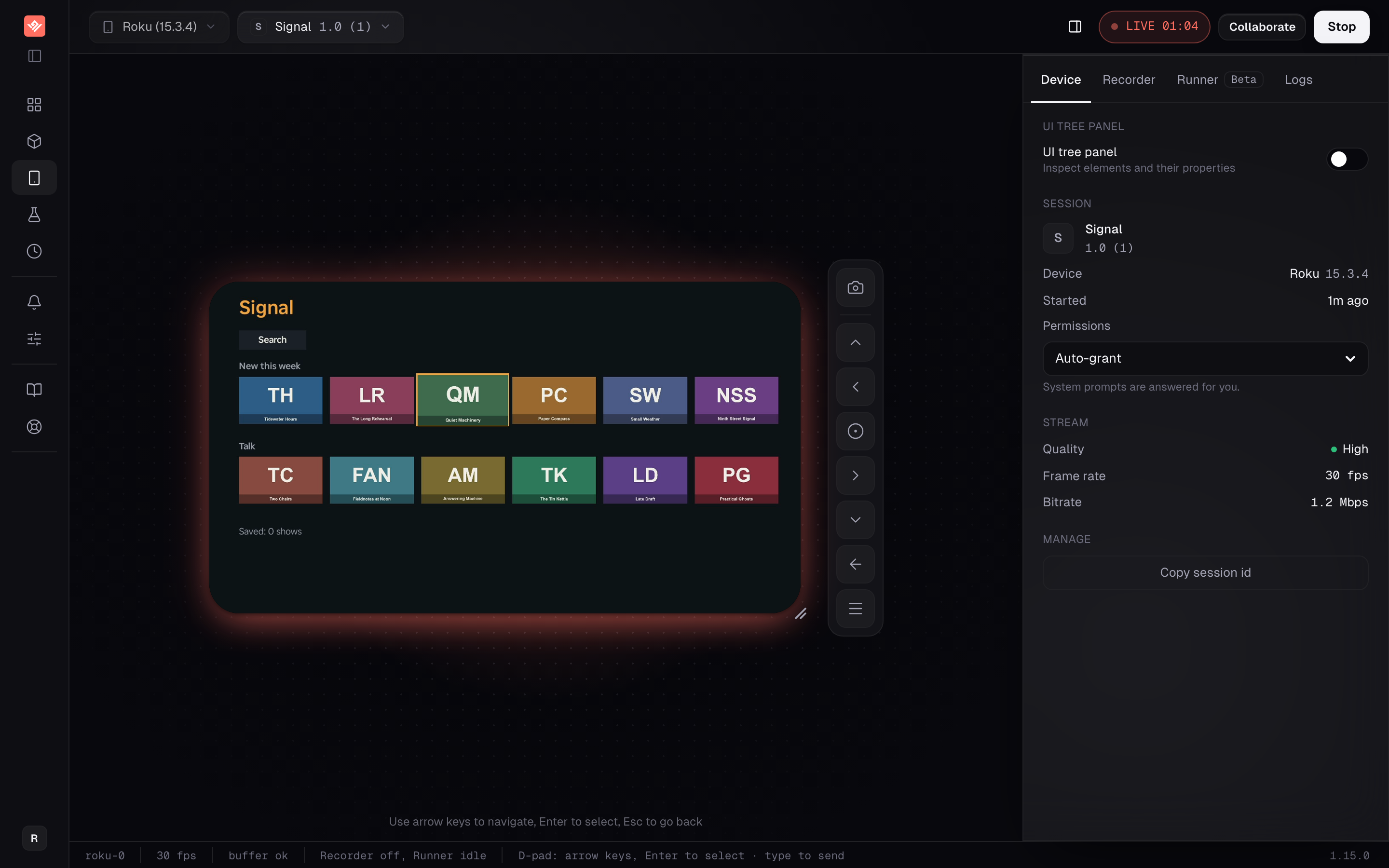
Roku app testing works differently here, and the differences run in both directions.
The good one first: there is no Roku emulator, from Roku or anyone else. So a Roku session streams a real physical device to your browser — the same hardware your viewers own, not an approximation of it. On every other platform we support, you are driving a simulator. Here you are not.
The honest one second: Roku support is in beta, and two things are missing. You cannot upload your channel to a device, and there is no automated test runner. Read the limits section before you plan around this.
Who this is for
Teams whose Roku channel is already deployed and who need people to reach a real device without one being on their desk — a QA engineer in another country, a support agent reproducing a viewer's bug, a producer reviewing a build. If you need to install your own channel yourself, or you want automated runs, this beta does not do that yet.
What works today
Real hardware, not a simulator
Sessions stream a physical Roku device. Playback, performance and platform behaviour are the real thing, because the device is the real thing.
The full remote, from your keyboard
Arrow keys move the d-pad, Enter is OK, Escape is back. No remote to borrow and no device to be sitting next to.
Typing that just works
When a Roku on-screen keyboard has focus, printable keys go straight to it and Backspace deletes. There is no separate typing mode to enter first.
UI tree inspection
Inspect the elements the device reports while you work. Coordinates are best-effort, so treat highlighted positions as approximate rather than exact.
Sessions stay inside your app
A shared physical device has a failure mode a simulator does not: someone navigates to the home screen, opens a different channel, and the next person to connect finds the device somewhere unexpected.
Roku sessions are confined to the app under test. System and home navigation is blocked, and if the device leaves the app for any reason, the app is brought back automatically. The device you hand to a colleague is the device they get.
What is not there yet
No app upload or sideload. The app under test must already be installed on the device. You cannot push a build the way you can on our iOS, Android and Apple TV devices, and this is the limit most likely to disqualify the beta for you.
No automated test runs. The AI test runner does not support Roku sessions. Recording flows, replaying them and running suites in CI — all of which work on our other platforms — do not apply here yet.
Approximate coordinates. UI tree inspection works, but element positions are best-effort. Use it to understand structure, not to measure layout.
Beta means beta. This is the narrowest platform we support, and it is newer than the rest. If Roku is the centre of your testing strategy rather than an edge of it, the honest answer today is that this covers streaming, control and inspection, and nothing beyond that.
What it is genuinely good at
Strip away what is missing and something specific is left: remote access to real Roku hardware, with reliable control and a view of the UI tree, from a browser anywhere.
That solves a real problem. Roku devices are cheap but physical, and a distributed team ends up with one device on one desk in one city. Reproducing a viewer's bug means asking the person who owns that desk. Streaming the device removes the desk from the equation without pretending a simulator would have caught the bug — because there is no simulator, and on Roku there never was.
Getting started
Because there is no sideload yet, this does not begin with an upload. Getting your channel onto a device is something we arrange with you, so support is the way in — tell us which channel you want on a device and what you need to do with it.
If you want the interaction model in detail first, TV testing covers the d-pad, focus and text-entry behaviour across all three TV platforms, and the UI Tree Inspector page covers what the inspector shows and how fresh its data is.
Frequently asked questions
Is this a Roku emulator?
No, and that matters. Roku publishes no emulator, so a Roku session here streams a real physical Roku device to your browser. Everything you see is running on the hardware your customers use — which is the opposite of our iOS, Android and Apple TV support, where the devices are simulators.
Can I upload my channel to a Roku device?
Not yet. App upload and sideload are not available on Roku, so the app under test has to already be installed on the device. This is the single biggest limit of the beta and the reason getting started involves talking to us rather than signing up and uploading a build.
Can I run automated tests against Roku?
Not yet. The AI test runner does not support Roku sessions. Streaming, remote control and UI tree inspection work today; automated runs do not. If a test runner on Roku is what you need, this beta will not give it to you.
How do I control the device?
The same keyboard model as our other TV platforms. Arrow keys move the d-pad, Enter is OK, Escape is back. Text entry works directly — when a Roku on-screen keyboard has focus, printable keys go straight to it and Backspace deletes, with no separate typing mode to switch into.
Can a session wander off into the Roku home screen?
No. Sessions are confined to the app under test: system and home navigation is blocked, and if the device leaves the app for any reason it is brought back automatically. A shared device does not end up parked on someone else's channel.
Are the UI tree coordinates accurate?
Treat them as approximate. UI tree inspection works on Roku sessions, but element coordinates are best-effort, so a highlighted position tells you roughly where an element is rather than exactly.
